
Chapter 7: The Map of Lines
To write down pitch, we need a vertical ladder. The higher you climb the ladder, the higher the note sounds.
7.1 The Staff
The musical “ladder” is called the Staff. It consists of 5 horizontal lines and the 4 spaces between them.
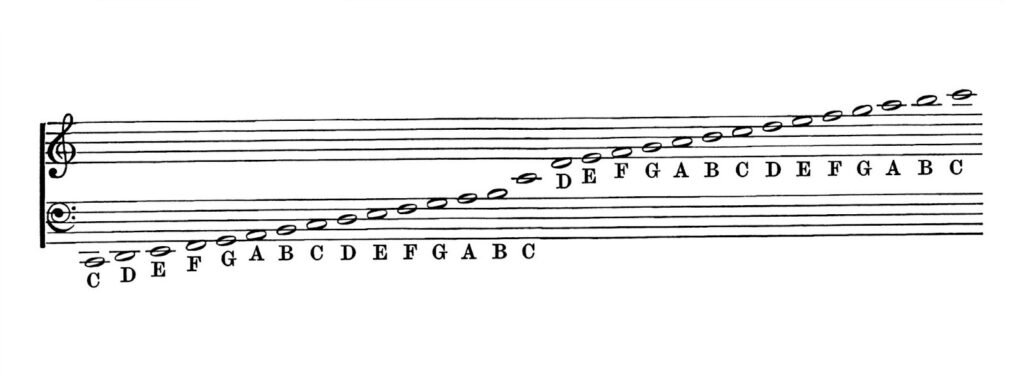
Old engraved illustration of Staff, Clef, and Notes to Play the Piano
- Rule: We count from the bottom up. The bottom line is Line 1; the top line is Line 5.
- Placement: A note can sit directly on a line (the line goes through the note head) or in a space.
7.2 The Treble Clef (G Clef)
This is the most famous symbol in music. It is used for High Pitch instruments (Guitar, Violin, Flute, Trumpet, and the Right Hand of the piano).
- The Shape: The big spiral circles around the second line from the bottom. This tells us that line is G.
- The Lines (Bottom to Top):E – G – B – D – F
- Mnemonic: Every Good Boy Does Fine.
- The Spaces (Bottom to Top):F – A – C – E
- Mnemonic: Spelling the word FACE.
7.3 The Bass Clef (F Clef)
This clef is used for Low Pitch instruments (Bass Guitar, Cello, Tuba, and the Left Hand of the piano).
- The Shape: It looks like a curved ear with two dots. The two dots surround the 4th line. This tells us that line is F.
- The Lines (Bottom to Top):G – B – D – F – A
- Mnemonic: Good Boys Do Fine Always.
- The Spaces (Bottom to Top):A – C – E – G
- Mnemonic: All Cows Eat Grass.
7.4 The Grand Staff & Middle C
Piano players read both clefs at the same time. We join them together with a brace to create the Grand Staff.
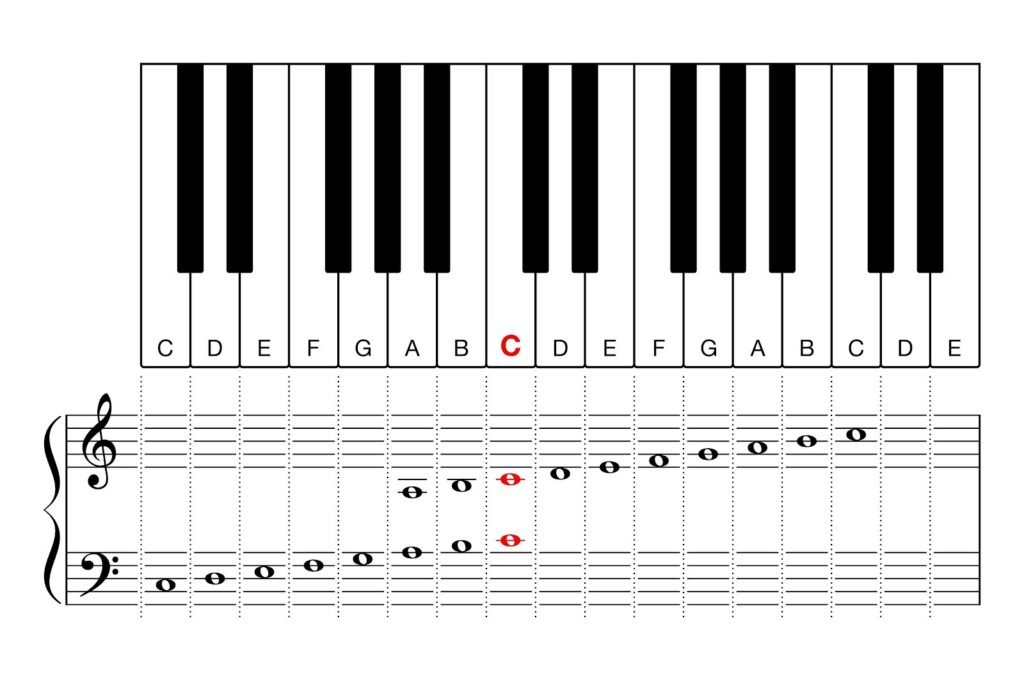
Middle C on a piano keyboard, learning aid and cheat sheet
- The Connector: The note that connects the two clefs is Middle C.
- It sits on a “Ledger Line” (a tiny temporary line) exactly halfway between the Treble and Bass staves.