
The Circle of Fifths
If you walk into any professional recording studio or music school, you will likely see a clock-like diagram on the wall. This is the Circle of Fifths. It is the “Periodic Table” of music—it organizes all 12 keys into a perfect mathematical loop.
13.1 How to Read the Circle
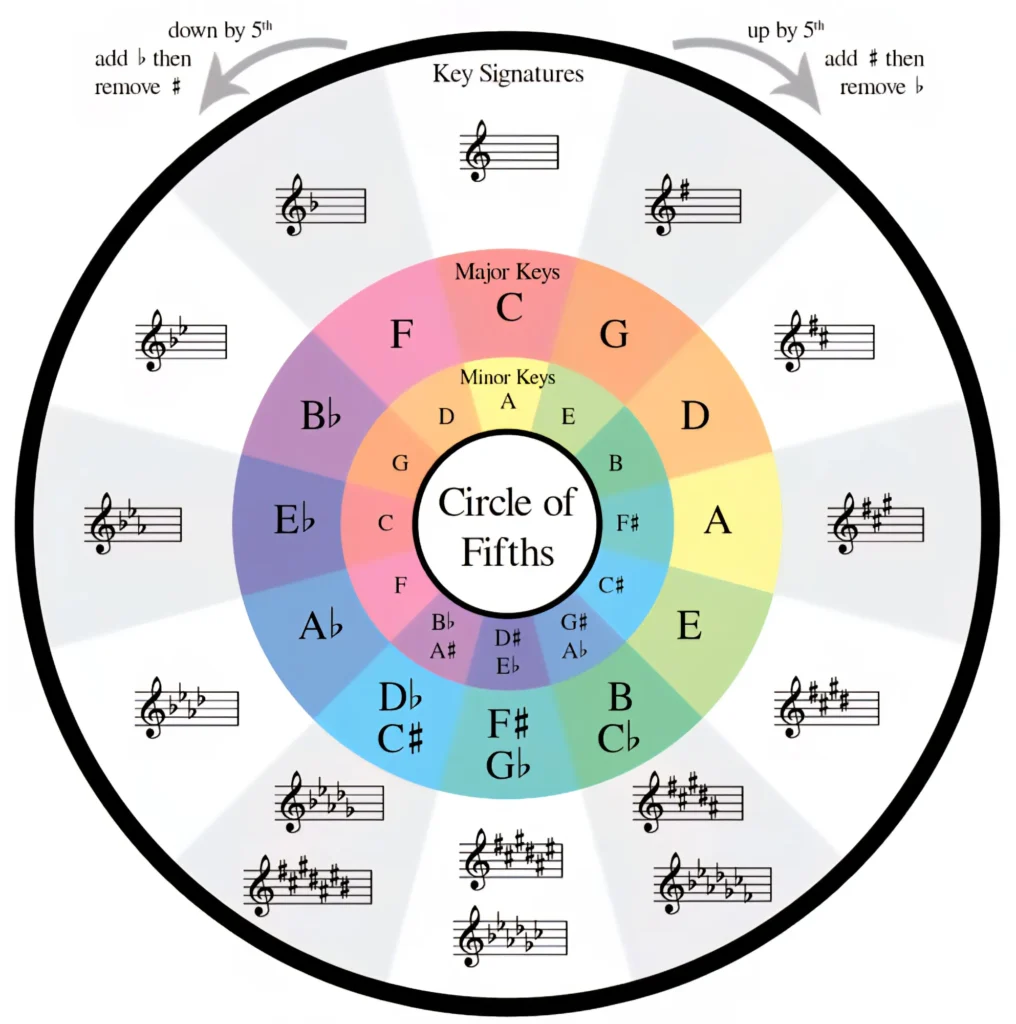
Imagine a clock face.
- 12:00 Position: C Major. (No Sharps, No Flats). Ideally neutral.
- Going Clockwise (The Sharp Side): Every time you move one “hour” to the right, you go up a Perfect 5th.
- 1:00 = G (1 Sharp)
- 2:00 = D (2 Sharps)
- 3:00 = A (3 Sharps)
- 4:00 = E (4 Sharps)
- 5:00 = B (5 Sharps)
- Going Counter-Clockwise (The Flat Side): Every time you move one “hour” to the left, you go down a Perfect 5th.
- 11:00 = F (1 Flat)
- 10:00 = B♭ (2 Flats)
- 9:00 = E♭ (3 Flats)
13.2 Why is this useful?
- Prediction: If you know a song is in E Major, the circle tells you instantly it has 4 sharps.
- Composition: Keys that are next to each other on the circle sound good together. C Major mixes well with G Major. It does not mix well with F# Major (which is on the opposite side of the circle).