
Key Signatures (The Code at the Start)
Musicians are lazy. We don’t want to write a sharp symbol next to every single F note in a song if the whole song is in G Major. Instead, we put a “Global Instruction” at the start of the line.
14.1 The Order of Sharps
When sharps appear in a key signature, they always appear in the exact same order. You will never see a key with only a D#.
- The Order: F — C — G — D — A — E — B
- Mnemonic: Father Charles Goes Down And Ends Battle.
14.2 The Order of Flats
The order of flats is exactly the reverse of the sharps.
- The Order: B — E — A — D — G — C — F
- Mnemonic: Battle Ends And Down Goes Charles’ Father.
14.3 The “Cheat Codes” for Identification
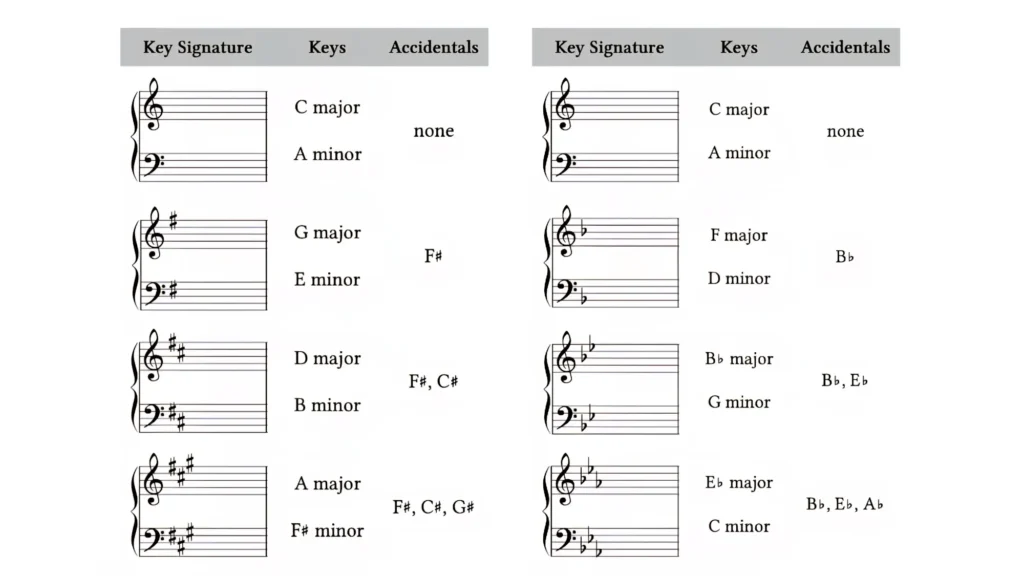
How do you look at a Key Signature and know what Key it is?
- For Sharp Keys: Look at the last sharp (the one furthest to the right). Go up one half-step. That is your Key.
- Example: Key signature has F# and C#. The last sharp is C#. One half-step up from C# is D. The key is D Major.
- For Flat Keys: Look at the second-to-last flat. That note is your Key.
- Example: Key signature has B♭, E♭, A♭. The second-to-last flat is E♭. The key is E♭ Major.
- Exception: F Major only has one flat (B♭). You just have to memorize that F Major has one flat.