The Minor Scales (The Dark Side)
While the Major scale sounds happy and triumphant, the Minor scale sounds sad, serious, or dramatic.
12.1 The Natural Minor Formula
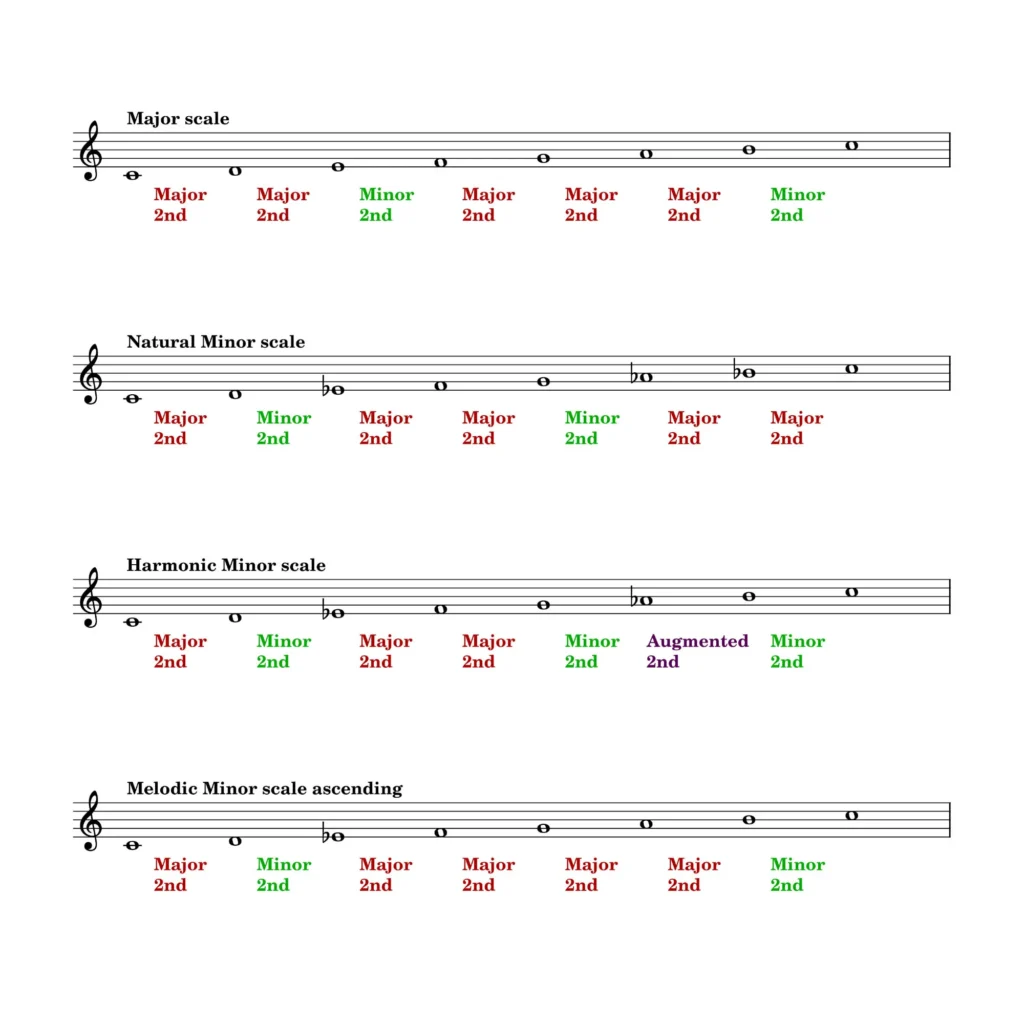
To build a Minor scale, we change the pattern of steps. The Minor Code: W — H — W — W — H — W — W
12.2 Relative Minor (The Cheat Code)
You don’t actually have to memorize a new code. Every Major scale has a “sad twin brother” hiding inside it. This is called the Relative Minor.
The Rule: Go to the 6th note of any Major Scale. Start playing the exact same notes from there. You have just created a Minor scale.
Example (C Major):
- Notes: C – D – E – F – G – A – B – C.
- The 6th note is A.
- If you play A to A using the white keys (A-B-C-D-E-F-G-A), you get the A Natural Minor Scale.
- They share the exact same DNA (same notes), but starting on a different note changes the “Gravity” (Tonal Center) and makes it sound sad.
12.3 The Three Flavors of Minor
Minor scales are trickier than Major scales. Composers over history tweaked them to fix certain sound problems.
- Natural Minor: The standard version (Aeolian Mode). Sounds ancient and folk-like.
- Harmonic Minor: We raise the 7th note by one half-step. This creates a “Snake Charmer” or exotic Egyptian sound. It is crucial for classical harmony.
- Melodic Minor: We raise both the 6th and 7th notes when going up the scale, but lower them back to normal when going down. (Used frequently in Jazz).