
Intervals (The Distance Between Notes)
If notes are the “bricks” of music, intervals are the mortar that holds them together. The emotional feeling of a song doesn’t come from the notes themselves, but from the distance between them.
10.1 Naming the Distance
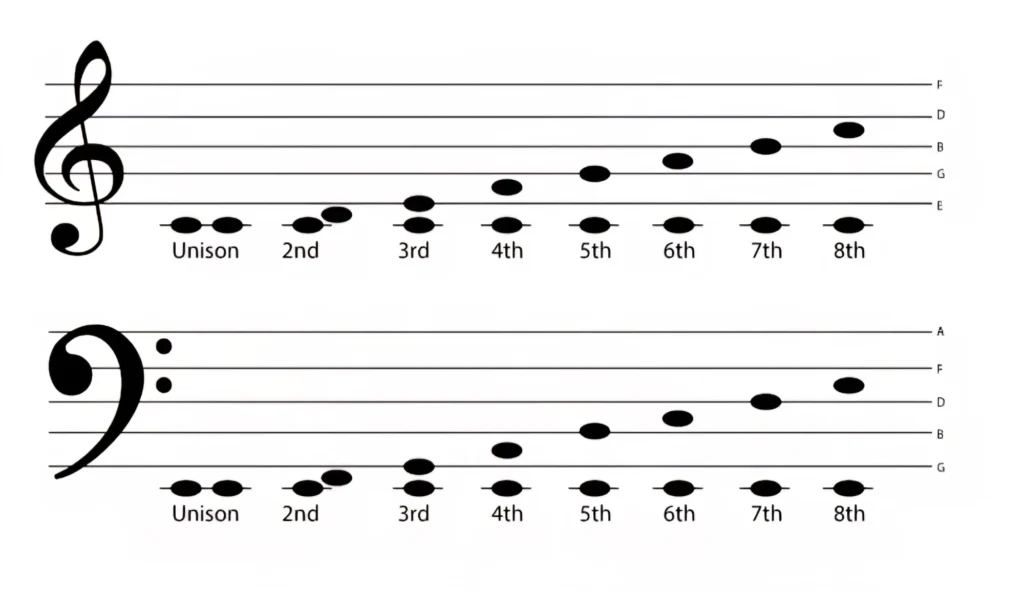
To name an interval, we count the number of letter names from the starting note to the ending note (inclusive).
- C to D: C (1), D (2). This is a 2nd.
- C to E: C (1), D (2), E (3). This is a 3rd.
- C to G: C-D-E-F-G. This is a 5th.
- C to C (High): This is an 8th (Octave).
10.2 Quality of Intervals
Just counting the number isn’t enough. We need to measure the specific quality.
- Perfect Intervals: The 1st (Unison), 4th, 5th, and 8th. These sound hollow, strong, and stable. They never change to “Major” or “Minor.”
- Imperfect Intervals: The 2nd, 3rd, 6th, and 7th. These can be Major (Happy/Big) or Minor (Sad/Small).
The Master List of Feelings:
- Minor 2nd (Jaws Theme): Very tense, creepy.
- Major 3rd (Doorbell): Happy, bright.
- Minor 3rd (Lullaby): Sad, melancholic.
- Perfect 5th (Star Wars): Heroic, stable, empty.
- Tritone (The Devil’s Interval): Exactly between the 4th and 5th. It sounds incredibly unstable and evil (used in heavy metal and horror movies).