The “In-Between” Notes (Accidentals)
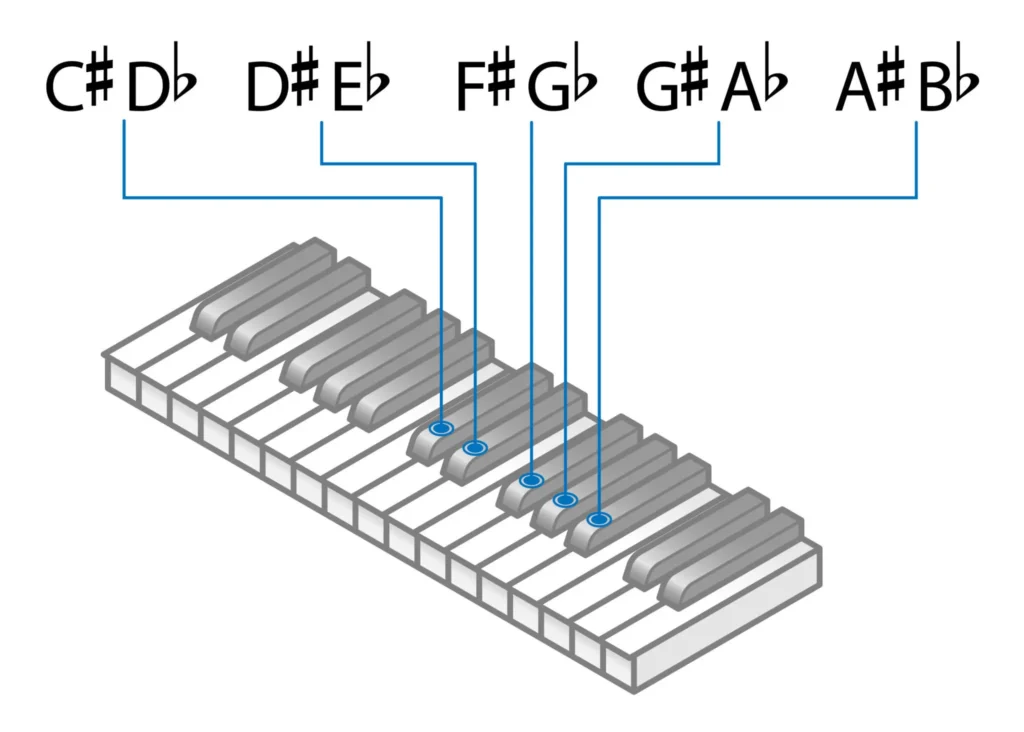
If you look at a piano, you see White Keys and Black Keys.
- The Staff lines (A, B, C, D, E, F, G) only represent the White Keys.
- To write the Black Keys, we use symbols called Accidentals.
8.1 The Symbols
- The Sharp (♯)
- Action: Raises the note by one half-step (Play the key to the immediate right).
- Visual: Looks like a hashtag.
- Example: C♯ is the black key just above C.
- The Flat (♭)
- Action: Lowers the note by one half-step (Play the key to the immediate left).
- Visual: Looks like a lowercase ‘b’.
- Example: B♭ is the black key just below B.
- The Natural (♮)
- Action: Cancels a previous Sharp or Flat. It tells you to return to the “white key” (Natural note).
8.2 The Rules of the Road
- Placement: When writing music, the symbol goes before the note head (to the left). When speaking, we say the word after the letter (e.g., “F Sharp”).
- The Measure Rule: An accidental lasts for the entire measure. If you make an F into an F♯ on beat 1, and you see another F on beat 4, it is automatically an F♯ too. The bar line resets everything back to normal.