The Mathematics of Duration (Note Values)
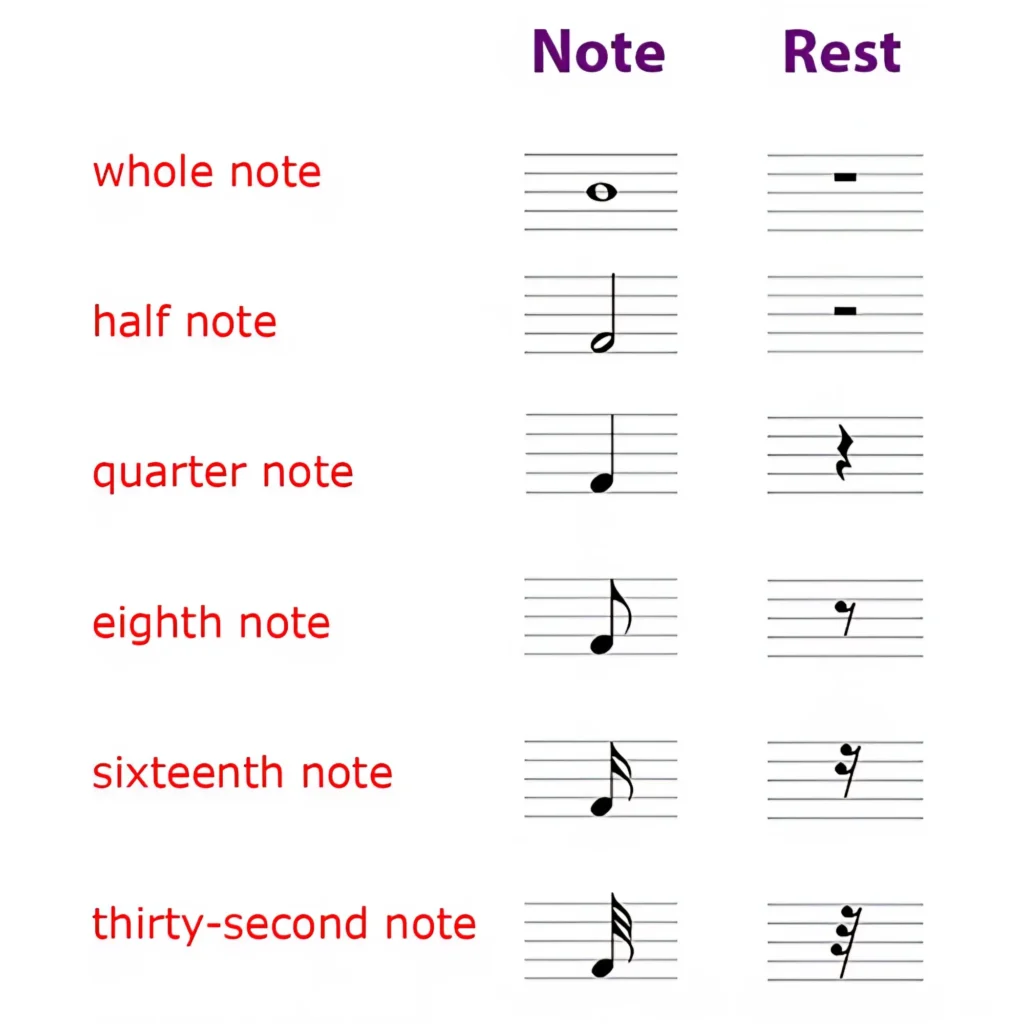
Now that we have a beat, we need symbols to tell the musician how many beats to hold a note for. Music notation is essentially a system of fractions.
4.1 The Note Pyramid
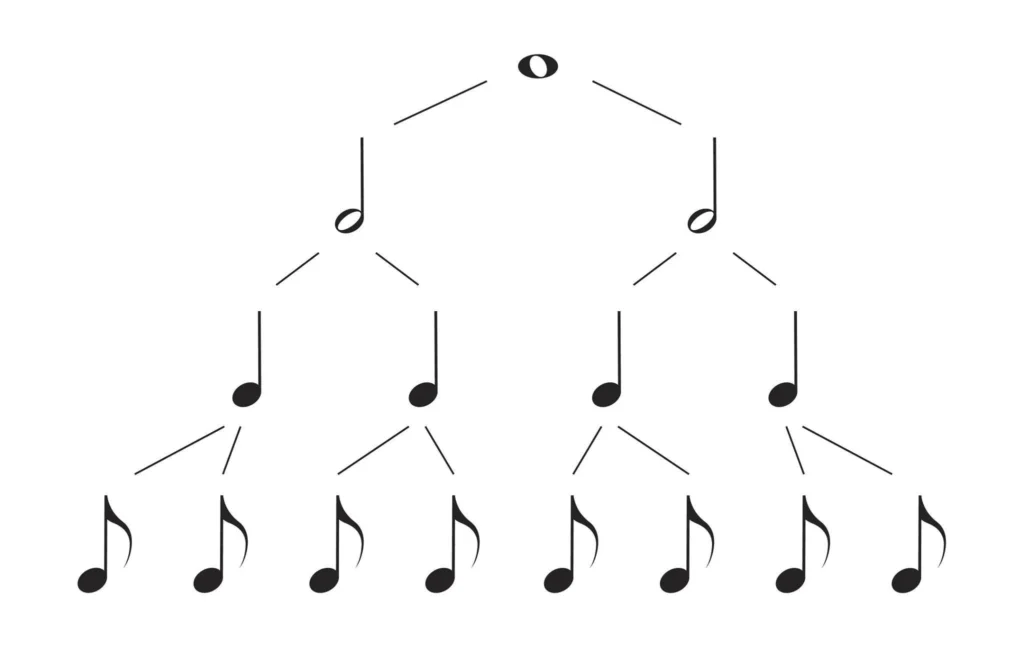
We start with the largest note and slice it in half, over and over again.
- The Whole Note (Semibreve)
- Symbol: An empty oval (O).
- Value: 4 Beats.
- Action: You play the note on beat 1, and hold it while you count “2, 3, 4.”
- The Half Note (Minim)
- Symbol: An empty oval with a stick (stem) going up.
- Value: 2 Beats.
- Math: Two Half Notes = One Whole Note.
- The Quarter Note (Crotchet)
- Symbol: A filled-in black oval with a stem.
- Value: 1 Beat.
- Context: This is the standard “tap” of your foot. In a standard “4/4” bar, there are 4 of these.
- The Eighth Note (Quaver)
- Symbol: A black note with a stem and one flag (tail) on the end.
- Value: ½ of a Beat.
- Counting: We count these by adding an “And” between the numbers: “One-And, Two-And, Three-And, Four-And.”
- Beaming: When two 8th notes are next to each other, we connect their flags with a thick bar called a Beam.
- The Sixteenth Note (Semiquaver)
- Symbol: A black note with a stem and two flags.
- Value: ¼ of a Beat.
- Counting: “One-e-and-a, Two-e-and-a…”
4.2 The Dot (The Rule of Half)
Sometimes you will see a small dot placed right after a note (e.g., a dotted half note).
- The Rule: A dot adds half of the note’s value to the note.
- Example:
- A Half Note = 2 beats.
- The Dot = 1 beat (half of 2).
- Dotted Half Note = 2 + 1 = 3 Beats.
4.3 The Tie
A curved line connecting two notes of the same pitch.
- Rule: Glue the two notes together. You play the first one and hold it for the duration of both. You do not re-strike the second note.