The Pulse and the Beat
Music does not exist in space (like a painting); it exists in time. To measure time in music, we do not use seconds or minutes. We use Beats.
3.1 The Heartbeat of Music
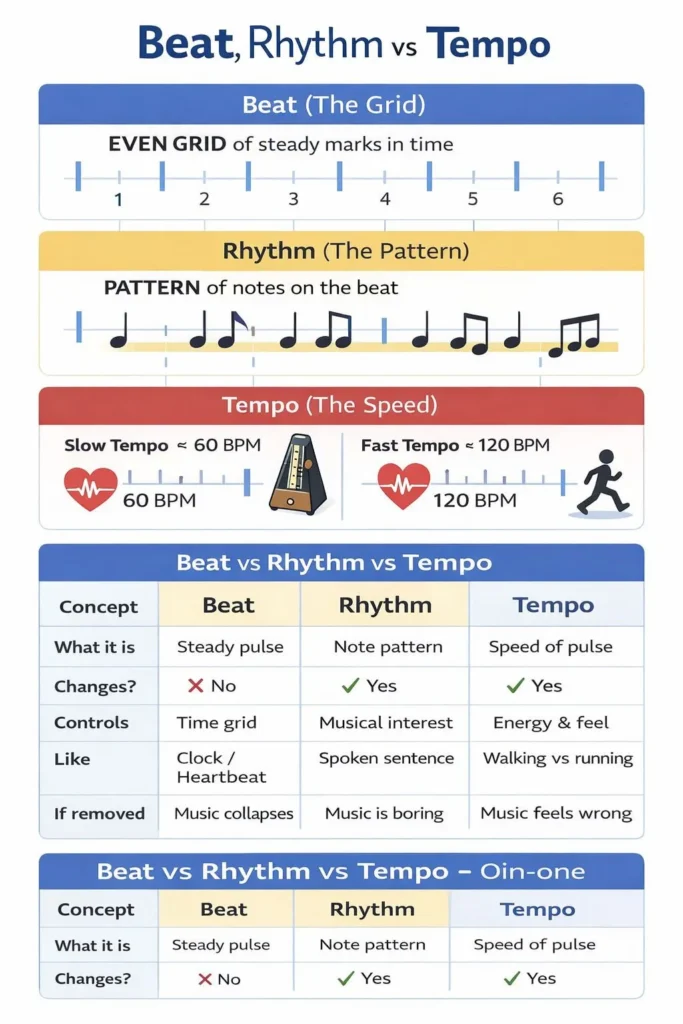
The Beat is the steady, recurring pulse that underlies the music. It is the “invisible grid” that holds everything together.
- When you tap your foot to a song on the radio, you are tapping the beat.
- The beat must be steady (like a clock tick), or the music will fall apart.
3.2 Tempo (The Speed)
The speed of the beat is called Tempo (Italian for “Time”). We measure tempo in BPM (Beats Per Minute).
- 60 BPM: Exactly one beat per second (The speed of a resting heart).
- 120 BPM: Two beats per second (The standard speed of a Pop or Disco song).
Classical Tempo Markings: Before digital metronomes, composers used Italian words to describe the “feeling” of the speed:
- Largo: Very slow and broad (40–60 BPM).
- Adagio: Slow and at ease (66–76 BPM).
- Andante: “Walking” pace (76–108 BPM).
- Allegro: Fast, happy, and bright (120–168 BPM).
- Presto: Very fast (168–200 BPM).
3.3 Beat vs. Rhythm (The Crucial Difference)
Beginners often confuse these two words.
- The Beat is the background pulse (It doesn’t change).
- The Rhythm is the actual pattern of notes played by the instruments (It changes constantly).
Analogy: Imagine you are walking down the street at a steady pace.
- Your footsteps are the Beat (Left, Right, Left, Right).
- The words you are speaking as you walk are the Rhythm (Some words are long, some are short, but your feet keep walking steadily).