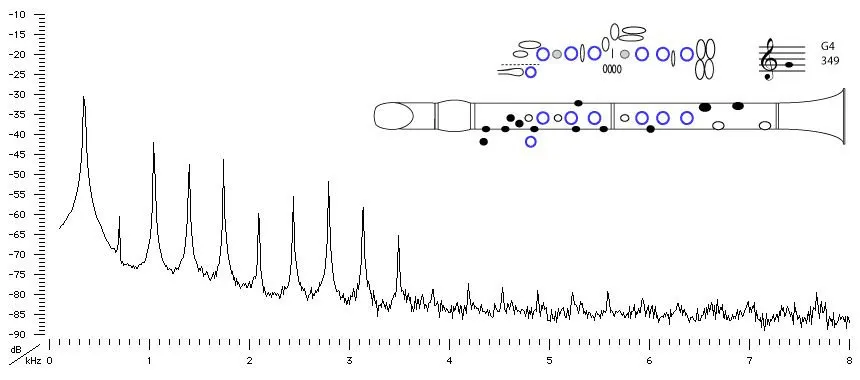
The Hidden Rainbow (The Harmonic Series)
If you strike a single key on a piano, say “Low C,” you think you are hearing one note. You are wrong.
You are actually hearing a symphony of dozens of fainter, higher notes hiding inside that one “Low C.” These hidden notes are called Overtones (or Harmonics), and they are the DNA of music. Understanding them is the key to understanding harmony.
2.1 The Fundamental Frequency
When a guitar string vibrates, it moves back and forth along its entire length.
- This main, big vibration creates the loudest sound you hear.
- We call this the Fundamental Frequency.
- If we say a note is “Low C,” we are naming it after this fundamental frequency.
But the string is not just vibrating as one long wire. It is also wobbling in smaller sections at the exact same time.
2.2 The Natural Ladder (The Overtone Series)
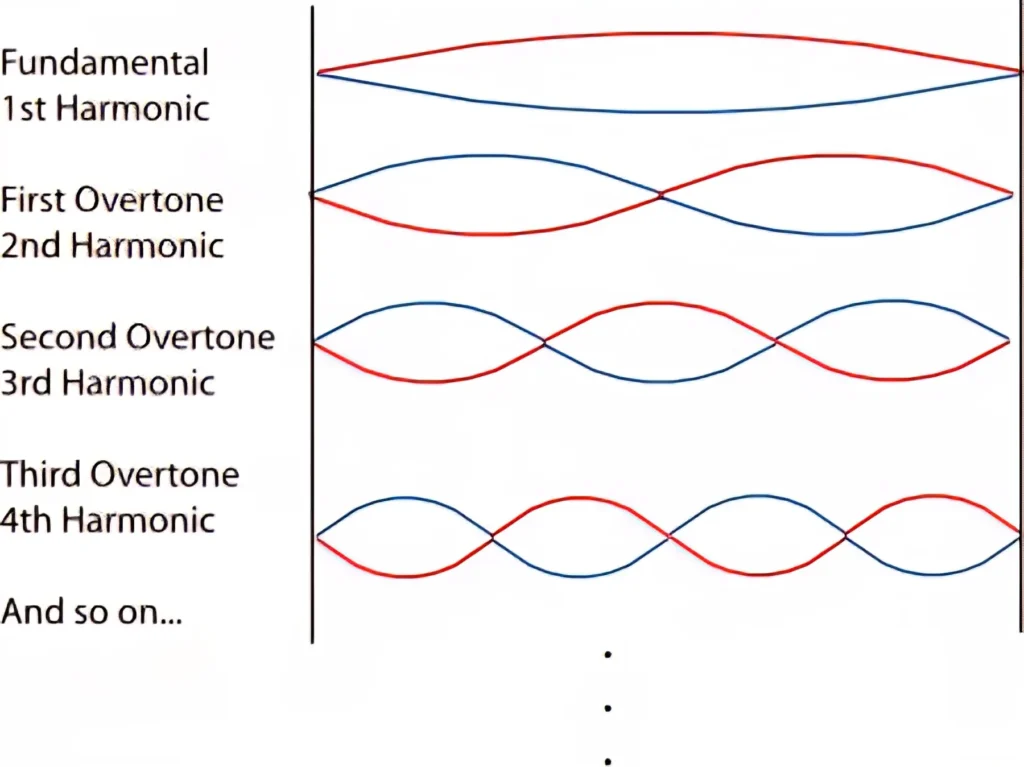
Imagine a rope tied to a wall.
- 1st Harmonic (Fundamental): You swing the rope, and the whole thing arcs up and down.
- 2nd Harmonic: At the same time, the rope vibrates in two halves (like a figure 8 sideways). This produces a sound exactly one octave higher.
- 3rd Harmonic: The rope vibrates in three equal parts. This produces a sound a Perfect 5th higher.
- 4th Harmonic: The rope vibrates in four parts. This produces a sound two octaves higher.
The Miracle of Math: Nature follows a strict mathematical ratio. If your Fundamental note vibrates at 100 Hz (100 times a second), the overtones will always be perfect multiples:
- Fundamental: 100 Hz (Low C)
- 2nd Harmonic: 200 Hz (Middle C)
- 3rd Harmonic: 300 Hz (The note G)
- 4th Harmonic: 400 Hz (High C)
- 5th Harmonic: 500 Hz (The note E)
Key Takeaway: Notice that the first few harmonics are C, C, G, C, E.
- C – E – G.
- Does that look familiar? It is the Major Triad.
- Music theory was not invented by humans; it was discovered in nature. The Major chord sounds “happy” and “stable” to us because it is physically built into the vibration of every single sound in the universe.
2.3 The Secret of Timbre
In Chapter 1, we asked: Why does a flute sound different from a violin?
The answer is The Overtone Recipe. Every instrument produces the same list of overtones, but at different volumes.
- The Clarinet: It produces very loud odd-numbered harmonics (1, 3, 5) and very quiet even ones. This gives it a “hollow” or “woody” sound.
- The Trumpet: It produces very loud, high-pitched harmonics. This gives it a “bright” or “brassy” sound.
- The Flute: It is almost pure Fundamental with very few overtones. This gives it a “pure” or “smooth” sound.
- The Snare Drum: It produces chaotic, non-mathematical overtones. This creates “Noise” rather than a note.
2.4 Pythagoras and the Hammer
The discovery of this math is often credited to the Greek philosopher Pythagoras (around 500 BC).
The legend says he was walking past a blacksmith’s shop and heard hammers hitting anvils. He noticed some hammers sounded good together (consonant) and some sounded terrible together (dissonant).
He went home and experimented with strings. He found:
- If you divide a string exactly in half (1:2 ratio), it produces the same note, just higher (The Octave).
- If you divide a string by thirds (2:3 ratio), it produces a new note that sounds perfect with the first one (The Fifth).
This was the birth of music theory: Music is geometry you can hear.
Review of Volume I
We have now established the physics.
- Sound is vibration.
- Pitch, Duration, Volume, and Timbre are the four variables.
- Every note contains a hidden “Major Chord” inside it (The Overtone Series).
We are now ready to leave the physics lab and enter the music room. It is time to learn how to write this down.