
What is Sound?
Before we touch a piano or pluck a guitar string, we must understand the invisible material we are sculpting: Sound.
Most people think sound is something that “happens” in the air. But strictly speaking, sound is a relationship between a vibration and a brain.
1.1 The Definition of Sound
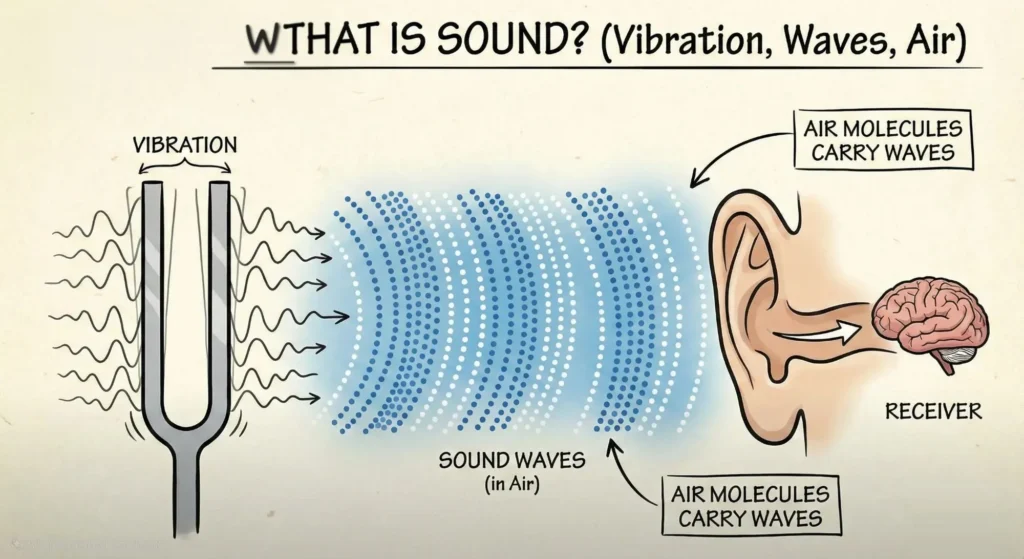
Sound is a physical disturbance in a medium (like air, water, or metal) that travels as a wave and is detected by the ear.
Imagine a calm lake. If you drop a stone into the center, ripples move outward in perfect circles.
- The Stone is the instrument (the source).
- The Water is the air.
- The Ripple is the sound wave.
When a guitarist plucks a string, the string vibrates back and forth. This vibration pushes the air molecules next to it. Those molecules push the ones next to them, creating a chain reaction. When this invisible chain reaction hits your eardrum, your brain translates it into “Sound.”
1.2 Sound vs. Noise
This is the most critical distinction for a musician. If all music is sound, is all sound music? No.
Definition of Noise:
Noise is disorganized sound. The sound waves are chaotic, random, and have no repeating pattern.
- Examples: The static of a TV, the crash of a dropped plate, wind blowing through trees.
- Visual: If you drew noise, it would look like a scribbled mess of jagged lines.
Definition of Musical Tone:
A musical tone is organized sound. The sound waves are periodic, meaning they vibrate in a strict, repeating pattern.
- Examples: A flute holding a note, a hum, a guitar string.
- Visual: If you drew a musical tone, it would look like a perfect, smooth wave (a sine wave).
The Musician’s Goal:
Our job is to take the chaos of the world and organize it into patterns. We are architects of air.
1.3 The Four Properties of Tone
Every single musical note you will ever hear—from a Mozart symphony to a heavy metal guitar solo—consists of exactly four ingredients. If you change one of these, the sound changes.
- Pitch:
- Definition: How “high” or “low” the sound is.
- The Physics: Pitch is determined by Frequency (how fast the vibration is).
- Fast Vibration = High Pitch (e.g., a whistle, a mosquito).
- Slow Vibration = Low Pitch (e.g., thunder, a bass drum).
- We measure this in Hertz (Hz). One Hertz means “one vibration per second.”
- Duration:
- Definition: How long the sound lasts.
- The Musical Term: Rhythm.
- Some sounds last for milliseconds (a clap); others can last for minutes (an organ note).
- Intensity (Dynamics):
- Definition: How loud or soft the sound is.
- The Physics: This is determined by Amplitude (how “big” the wave is).
- If you pluck a guitar string gently, it vibrates a small distance (Quiet).
- If you pluck it hard, it vibrates a large distance (Loud).
- Timbre (Tone Color):
- Definition: The “personality” of the sound. It is what makes a piano sound different from a trumpet, even if they are playing the exact same pitch at the same loudness.
- Pronunciation: “TAM-ber” (rhymes with Amber).
- Timbre is why we can recognize our mother’s voice on the phone instantly.